According to CDC data, roughly 40 million U.S. adults cannot swim, and more than half have never taken a swimming lesson. If you are one of them, raising a child in Gilbert, Chandler, or anywhere in the East Valley, where backyard pools are standard and water exposure starts early, can feel overwhelming.
Your child's water safety does not depend on your ability to do a lap across the pool. Parents who can't swim can absolutely raise water-safe children by combining the right swim instruction, consistent safety habits, and a few practical adjustments. None of it requires you to get in the deep end yourself.
Research shows a direct link between parental swimming ability and children's water competency. When parents have limited skills, their children are significantly less likely to develop proficient abilities on their own.
In Gilbert and Chandler, this dynamic carries extra weight. Most homes have pools, and children encounter water at friends' houses, parks, and gatherings from a very young age. A parent who is afraid of water may unintentionally delay enrolling their child in lessons or avoid pool environments altogether.
Drowning remains the leading cause of death for U.S. children ages 1 to 4, and drowning prevention for families starts with recognizing that enrolling your child in swim lessons is among the most effective steps available, regardless of your own comfort level.
Raising a water-safe child does not require a radical lifestyle change. A few targeted actions make a meaningful difference:
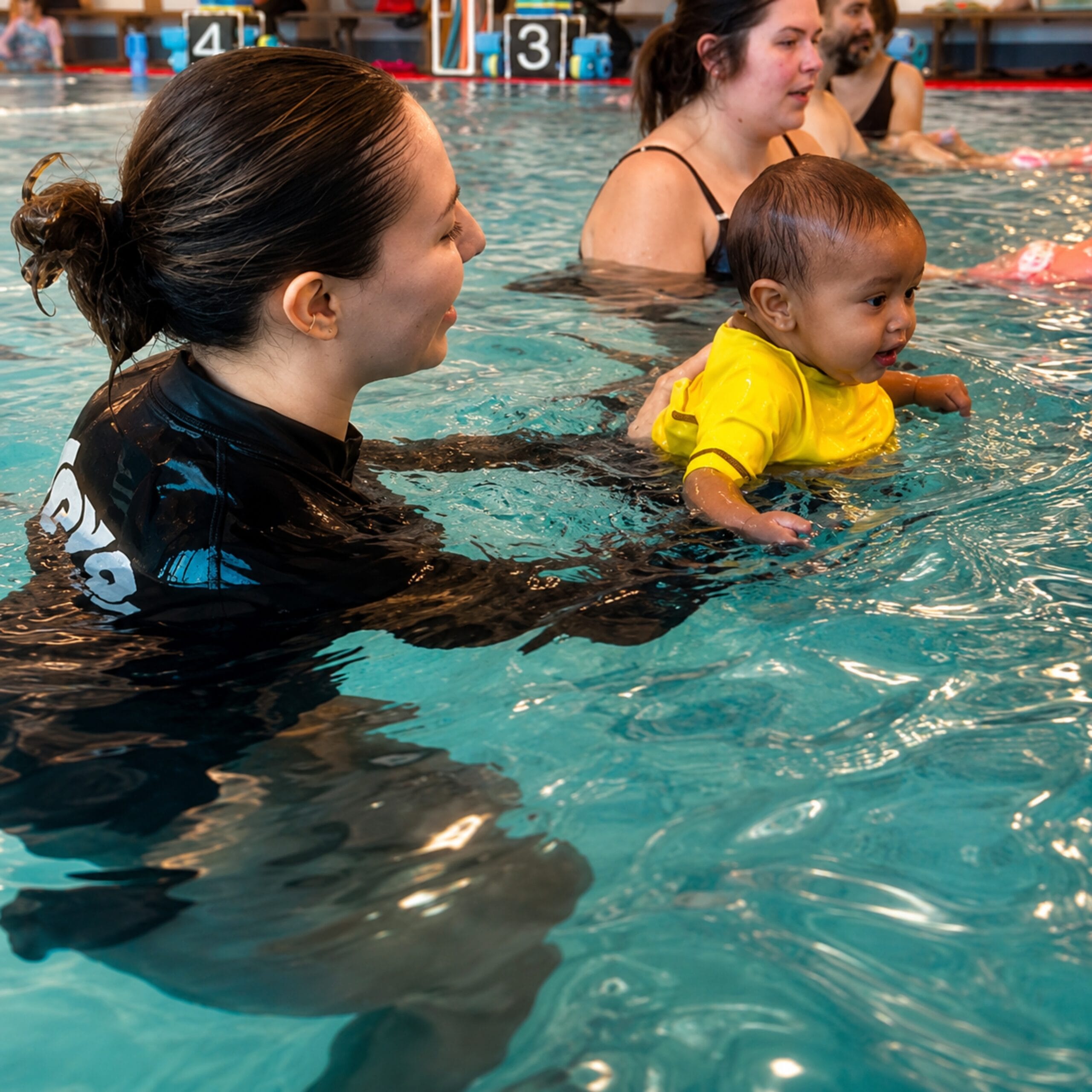
The AAP supports swim lessons for children starting at age 1, and parent-tot classes are available for infants as young as 3 months. Infant swim lessons in Gilbert, AZ give babies early water exposure in a structured setting, even if the parent in the water is not a strong swimmer.
At EVO Swim School, parent-tot classes like Starfish and Pufferfish are designed so the parent provides physical support while the instructor leads all teaching. You do not need to know how to swim to participate. As your child progresses, entry-level classes like the Otter (3:1) and Seal (4:1) transition them to instructor-led lessons without a parent in the water.
Supervision, not swimming ability, is the most critical drowning prevention tool. A designated adult should pay attention to children at all times near water. As a water watcher, stay focused:
You do not need to be a swimmer to be an effective water watcher. You need to be attentive, sober, and within arm's reach of young children.
Fear of water as a parent can quietly shape how you approach your child's relationship with swimming. If pool anxiety is high, your child may absorb that tension.
If you have a pool, Arizona law (A.R.S. § 36-1681) requires fencing at least 5 feet tall with self-closing, self-latching gates. Beyond the legal minimum:
You do not need swimming expertise to teach your child the basics. Start with these rules as soon as your child can understand simple instructions:
Repeating these consistently at home reinforces what your child learns during swim lessons, creating habits that carry over to every pool they encounter.
Parents who can't swim often worry they cannot help their child practice. In reality, the most impactful contributions have nothing to do with getting in the water.
Raising a water-safe child in Gilbert and Chandler does not require you to be a swimmer. Enroll your child in quality instruction early, maintain consistent attendance, supervise effectively, and secure your home pool. The gap between a parent who cannot swim and a water-safe child is not ability. The gap is action.
Ready to give your child the water skills you did not have growing up? Join us today and find the right class at EVO Swim School, or call us at 480-404-6191.
Yes. Parent-tot classes are held in shallow water, and the instructor leads all teaching. The parent provides physical support and comfort while the instructor guides every activity. You do not need swimming ability to participate.
Enroll your child in formal swim lessons and serve as an attentive water watcher whenever your child is near water. Supervision is the primary drowning prevention tool, and it does not require swimming ability.
Children can pick up on parental anxiety, but early, positive experiences in structured swim lessons help build an independent relationship with water. Starting lessons early, before your child has developed their own fears, gives them the best foundation.
The AAP supports swim lessons from age 1, and parent-tot water introduction is available as early as 3 months. For families where the parent cannot swim, starting early is especially valuable because it provides professional instruction from the beginning.
No. As Cleveland Clinic pediatrician Dr. Richard So notes, swim lessons help build skills and confidence, but children remain vulnerable in the water. Lessons are one critical layer of protection alongside adult supervision, pool fencing, and consistent enforcement of water safety rules.
Or register via phone 480-404-6191