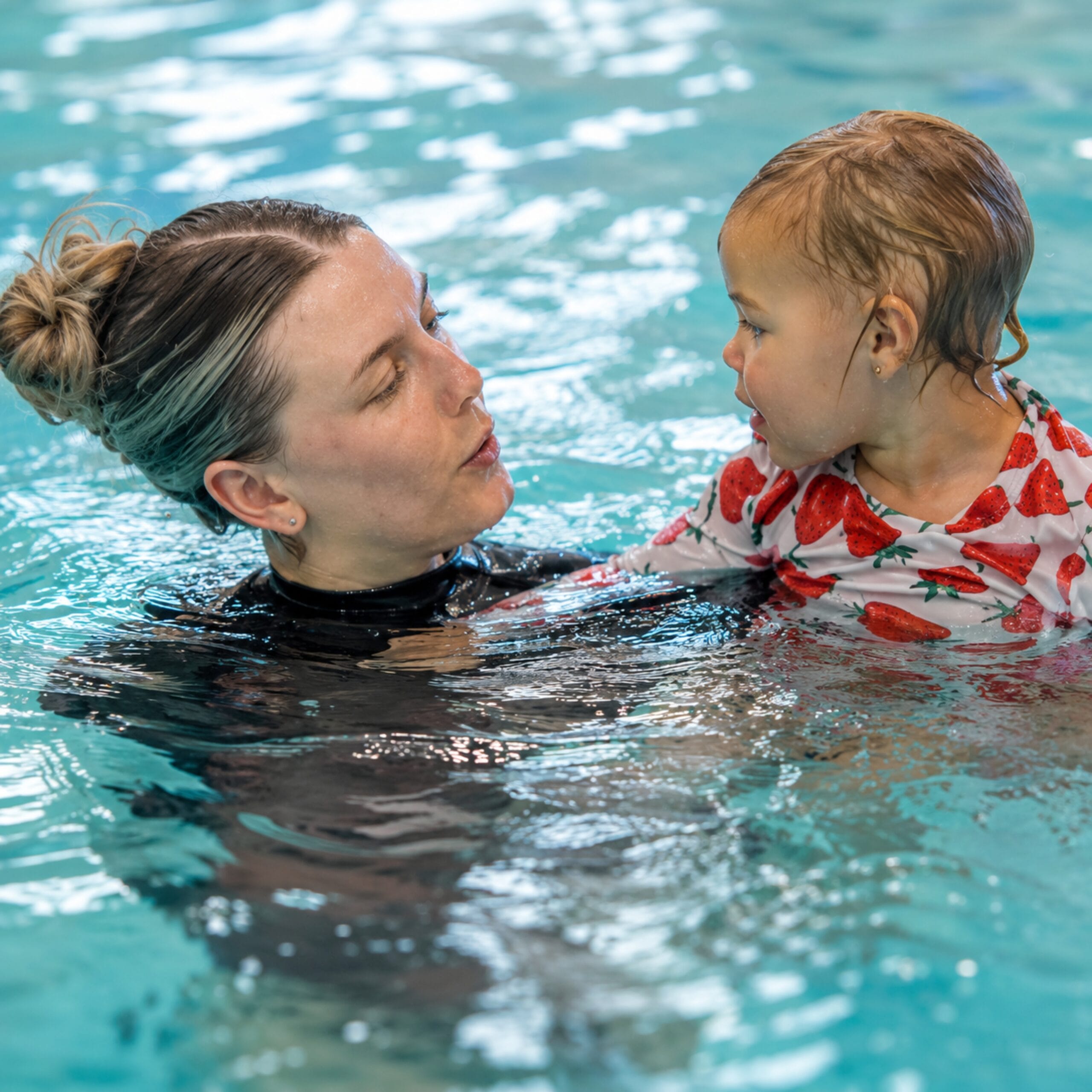
Summer in Sunland Village East means grandkids are visiting. School is out, parents are at work, and the community's three pools become the default activity. For the 2,400-plus households in this Mesa 55+ community, that is one of the best parts of the season.
But pool safety for grandkids requires a different level of attention than what most adults grew up practicing. Drowning remains the leading cause of unintentional death for children ages 1 to 4, and according to the CPSC, children can drown in as little as one inch of water. The good news: drowning is preventable, and grandparents are in a strong position to be part of that prevention.
Before covering pool rules and barriers, the single highest-impact action for water safety for grandparents is making sure the grandkids are enrolled in formal swim instruction. The AAP includes swim lessons as part of a broader drowning prevention strategy, and structured classes build the survival skills that matter when a child encounters water unexpectedly.
Swim lessons for grandchildren can begin as early as 3 months. At EVO Swim School,
Any authorized adult can enroll a child, so grandparents coordinating with parents on scheduling can handle registration directly.
EVO's Mesa location at 3727 S. Power Rd. (Mesa, AZ 85212) is a short drive from Sunland Village East. Indoor, climate-controlled pools mean swim lessons in Mesa, AZ run year-round, not just during summer visits. A parent viewing room makes it comfortable to bring the whole crew. If the grandkids visit regularly, consistent weekly enrollment during their stays builds muscle memory and water confidence that sticks between visits.
If it has been 20 or 30 years since you had small children around a pool, a few important things are worth updating.
The CPR you may have learned decades ago is not the same protocol taught today. The CPSC's Pool Safely campaign notes that CPR has changed since today's grandparents learned it. Current guidelines emphasize chest compressions first, and the technique differs for infants, children, and adults. A refresher through the American Red Cross or a local Mesa community center brings your skills current.
Active supervision drowning prevention means one designated adult whose only job is watching the water. No phone, no book, no conversation. Rotate every 15 minutes to stay sharp.
The water watcher has to be someone physically able to quickly reach a child in distress. Drowning is fast and typically silent. Nearly 70% of drowning incidents involving children under 5 happen during non-swim times, when the child was not expected to be in the water.
Arm floaties, puddle jumpers, and inflatable rings give children and grandparents a false sense of security. Only U.S. Coast Guard-approved life jackets are rated for drowning prevention. Floatation toys hold children in a vertical position, which is the opposite of how swimmers move through water.
The community pools are a wonderful resource, but they come with the same considerations as any residential pool.
HOA pool rules govern access hours and general conduct, but they do not provide active lifeguard supervision. Once you and your grandchildren are inside the pool gate, safety is entirely your responsibility.
Before the grandkids arrive:
If your home has a private pool or spa, Arizona law (A.R.S. § 36-1681) requires fencing at least 5 feet tall with a self-closing, self-latching gate. Beyond the legal minimum:
Water safety for grandparents works best as a routine, not a one-time conversation. Before the grandkids arrive:
Ready to give your grandchild the gift of water safety? Join us today and browse our class schedule, or call EVO Swim School at 480-404-6191.
Parent-tot water introduction classes accept infants as young as 3 months. A parent or authorized caregiver is in the water for the entire session, and the focus is on water acclimation and early comfort rather than independent swimming.
Strongly recommended. The CPSC and American Red Cross both emphasize that bystander CPR significantly improves outcomes after a drowning incident. Current techniques have changed since many grandparents were originally trained, so a refresher course is worthwhile even if you were previously certified.
The community pools do not employ lifeguards. All supervision responsibility falls on the adults accompanying children. Treat every visit with the same vigilance you would apply at an unsupervised backyard pool.
Assuming that being nearby equals supervising. Active supervision means one adult dedicated solely to watching the water, with no distractions. Most child drowning incidents occur during brief lapses in attention, not from barrier failures or equipment malfunctions.
Yes. Any authorized adult can serve as the in-water partner for parent-tot classes. Grandparents who regularly care for young grandchildren are welcome in these programs and do not need swimming expertise to participate, as the instructor leads all activities.
Or register via phone 480-404-6191